Sinew · pitch · GRAVITY 2026

We give robots the sense of touch — from ordinary video.

A robot arm's camera can't feel how hard it grips. We recover that missing force from the video itself — no new sensor — so robots learn to handle the real world.
manipulation video · in
🦾📦
force is happening here — but the camera can't see it
↓  recover force  ↓
touch model · trained on real force
↓  fill the missing channel  ↓
+ force · out
🦾📦 4.2 N
Sinew · IR
01 / 20
The problem

A robot with a camera can see the cup — but it can't feel it.

So it squeezes too hard and crushes it, or too soft and drops it. Almost every useful task — plug a cable, fold a shirt, fit two parts together — is decided by touch the camera never captures.
📷
What it sees

A camera gives pixels — shape and position. Useful, but flat.

🤲
What it misses

How hard it presses, when it makes contact, which way it pushes — all invisible.

What happens

Delicate and precise jobs fail — the robot is working blind to force.

In a factory, a 1% miss is a costly loss. Touch is what pushes success rates from "demo" to "production."
Problem
02 / 20
Why it's stuck

The data robots learn from is all video — and video has no force in it.

  • The world is building huge data factories — millions of hours of manipulation video. None of it records force.
  • You can't add force by hand — no human can watch a clip and label how many newtons the gripper pushed.
  • The only way to get force today is a physical force sensor on every arm — expensive, and it can't be bolted onto video you already shot.
R G B + F?
every video is R · G · B —
the force channel is empty
So the whole field is force-blind. That's the gap we fill.
Problem
03 / 20
The difference · before → after

Same robot. Same camera. Add the sense of touch — and the task works.
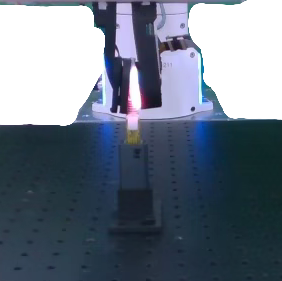
Today · camera only
manipulation video frame
Robot sees pixels, not force → it presses too hard or slips. Contact tasks stall.
+ Sinew · same hardware
recovered force overlay 4.2 N
We add the missing touch channel onto the same video → robot knows contact + how hard → task succeeds. No new sensor.
Live demo video plays here in the talk — same clip, force made visible.
Before → after
04 / 20
What we do

Video in → contact · direction · force out, frame by frame.

Ordinary manipulation videothe data you already have
Sinew touch modeltrained on real force data
Video + force, per framewhere · which way · how hard
A model trained on real force writes the missing touch channel back onto ordinary video. We're a generator, not a broker — we create a label that was never in the data, and hand it back in the customer's own format.
{
  "frame": 1042,
  "contact": true,
  "dir": [.0,-.8,.6],
  "force_N": 4.2
}
Product
05 / 20
How a new team onboards

Four steps — and nothing on the robot changes.

1 · Connectsend the video you already have — any format
2 · AugmentSinew adds the force channel, frame by frame
3 · Trainretrain your policy on the force-added data
4 · Deployrun on the same robot — no sensor
No new hardware, no re-collection — we work on data you already own.
You keep your stack — we only add the one missing label: force.
Adopt in layers — just contact already helps; direction + magnitude add more.
The two big questions we get — "do I need a force sensor?" and "do I recollect data?" — both answer no. Depth in appendix B–C.
How you use it
06 / 20
Proof · it works

Add force, and robots get the job right far more often.

Task success — vision only (π0 / VLA baselines)
47%
Task success — with recovered force (FD-VLA)
61%
Our contact detection — clean set (F1)
87%
■ vision only · ■ + Sinew force — external policy results (FD-VLA vs π0) + our internal contact eval.
61%vs 47% vision-only
87%contact detection (F1)
0 new sensorsruns on video you own
This is our technical edge: the force nobody else can recover, learned once from scarce real data and applied to any manipulation video. Honest: force is predicted, not measured — full benchmarks in appendix.
Proof
07 / 20
Where we start

Start sharp: automotive assembly — a global carmaker already asked us for exactly this.

Beachhead Contact-rich car assembly — insert, fasten, fit parts under force.
A partner in automotive hit the exact wall we solve: cameras alone can't run precise, force-sensitive assembly. We do one thing perfectly first — then expand.
Picking one beachhead doesn't box us in — the same force layer applies anywhere robots touch things.

Same technology, expanding outward:

🚗 Automotive assemblyfirst — a partner already needs it
📦 Logistics & warehouse pickingfragile / variable objects
🔌 Electronics assemblydelicate connectors, cables
🏠 Home & service robotsthe long-term prize
Market
08 / 20
Who buys

We become the force layer under everyone building physical AI.

Anchor customer: NVIDIA — the platform every robotics company builds on. Whoever owns the physical-AI stack needs force data they can't collect themselves.

Also in reach:

HyundaiLGSamsung GoogleRobot makers · UR · KUKA
Robotics companies & foundation-model labs
their policies & robots
↓ built on
Sinew — the force-data layer
Like NVIDIA is the platform under every AI app, we aim to be the touch data under every robot policy.
Market
09 / 20
How we make money

Sell the force back as a subscription — dataset & API.

Force-augmented dataset
  • Send us your force-blind video.
  • Get it back with a force channel, in your format.
  • Pay per hour of recovered data + license.
Force-Recovery API
  • Stream video → get contact · direction · force.
  • Usage-based, like any AI API (think ChatGPT/Claude).
  • Pay per use — more data through, more revenue.
Every clip a customer sends also makes our model better — and it costs nothing to run on video they already own.
Business
10 / 20
Team

Built by people who own the force problem.

Ivan Domrachev
Co-founder · CEO
KAIST IRiS Lab
Igor Alentev
Co-founder · CTO
KAIST IRiS Lab
Lev Kozlov
Co-founder · Head of Research
KAIST IRiS Lab
Hyeonseok Seong
Korea Ops · Hardware
KAIST IRiS Lab
Why this team wins force-from-video
  • From KAIST IRiS — the teleoperation & haptics lab (spinning out now).
  • Force-from-video is our research direction — the vision-meets-contact problem itself.
  • Shipped robots at scale — humanoid (Sber), contact-rich assembly (Hyundai), teleop (LG).
  • Robotics + ML + haptics in one team — the full stack force-from-video needs.
Advised by Prof. Jee-Hwan Ryu · KAIST
Team
11 / 20
The thesis
Give robots the sense of touch — recovered from the video they already have.
What we prove next One paid pilot in automotive assembly — force added to their own video, no new hardware, measurable lift in success rate.
Sinew · KAIST IRiS · advised by Prof. Jee-Hwan Ryu
Sinew
12 / 20
Appendix
Backup — for the questions after the 5 minutes.
How it works in depth · training pipeline · deployment pipeline · full benchmarks · market sizing · why it's hard to copy · business-model detail.
Appendix
13 / 20
A How it works

Three levels of touch — and it's object-centric, not tied to any robot.

1Contact

Did contact happen this frame? Yes/no — no force sensor needed, and already lifts policy performance.

2Direction

Which way the force points — recovered from the object's dynamics in the video.

3Magnitude

How hard, in newtons — the full signal, learned from our lab arm with a real F/T sensor.

Our labels are anchored to the object being handled, not a specific gripper. So any robot maker can use them — their arm just needs a small fine-tune to map onto its own embodiment.
We train on real force (lab arm + F/T sensor), learn to align it with video, then drop the sensor: video alone produces the force channel at inference.
Appendix · How
14 / 20
B Training pipeline

You train on force-augmented data — the same way you train today.

Your datasetvideo + actions · force-blind
Sinew augment+ contact · direction · force per frame
Your training loopone extra modality, same algorithm
Force-aware policyhigher success rate
  • No force sensor in the loop. Force enters training as recovered labels — not from hardware.
  • The policy is yours. How you consume force (observation, reward, auxiliary loss) stays on your side — we only add the label.
  • Adopt in layers. Start with contact (cheapest, already lifts success) → add direction → add magnitude.
Embodiment fit Labels are object-centric, so any arm can use them. To match your exact gripper, an optional light fine-tune on your unlabeled video (UDA) aligns the force onto your embodiment — no new data collection.
Appendix · Training
15 / 20
C Deployment pipeline

Two ways to run it live — both need no F/T sensor.

A · Baked in (offline / DaaS)
augmented data train once policy runs on vision

Force is learned into the policy at training time. At runtime: pure vision, zero Sinew dependency, zero sensor.

B · Online (streaming / API)
live camera Sinew API force → your controller

Per-timestep contact / direction / force streamed from the live feed. Still no physical sensor on the arm.

Same robot, same camera. No F/T hardware required either way.
Adding your own sensor later? A small fine-tune aligns our prediction to its placement — optional, not required.
Appendix · Deployment
16 / 20
D Benchmarks

Recovered force holds up past the setup it trained on.

0.94cross-robot contact AUC
6.4Mforce frames · 178 h
87%clean-set contact F1
16,772harmonized rollouts
7embodiments
contact F1 · trained end-to-end (in-dist)
0.26
0.94
cross-dataset direction · adapted (UDA)
0.40
0.85
cross-robot contact AUC · force embedding
0.80
0.94
■ baseline · ■ Sinew — AUC / F1 / cosine, 0–1 · internal eval (RH20T · FMB · REASSEMBLE · crisp).
In-distribution contact F1 0.26 → 0.94; adapted to a new dataset, direction 0.40 → 0.85; cross-robot contact AUC 0.80 → 0.94.
Honest: force is predicted, not measured; cross-dataset gains use unlabeled target video (adaptation, not zero-shot); zero-shot cross-lab direction is the open frontier.
Appendix · Traction
17 / 20
E Market sizing

A force layer attached to markets already worth tens of billions.

TAM
host markets — synthetic data + dataset licensing + embodied AI
SAM
$0.6–1.0B · contact-rich / force-decisive slice (2026–27)
SOM
$0.5–3M · Year-1 (2–5 pilots + 1 corpus license)
Bessemer: robotics will spend >$3B on training data in 2026–27 — and every existing corpus is force-blind.

Host markets we attach to — now → forecast (CAGR)

marketnowforecastCAGR
Synthetic data gen$0.58B$10.8B34%
Dataset licensing (AI)$4.8B$22.6B19%
Embodied AI (system)$4.4B$23.1B40%
Robotics manip. data$0.5B$13.5B~40%
Tactile sensors$5.4B$9.8B10–16%
Sources: Precedence, Grand View, MarketsandMarkets, Mordor + internal triangulation [EST]. Demand anchor: Bessemer.
Appendix · Market
18 / 20
F Why it's hard to copy

Data recovered, where everyone else needs hardware.

Harmonized multi-dataset corpus
RH20T12,666
REASSEMBLE2,262
FMB1,844
16,772 recordings · 178 h pulled into one end-effector label space — 4 conventions harmonized into 1.
Cross-robot generalization
FrankaFlexivUR5KUKA
7 robot configs across 4 datasets — recovered force holds up past the setup it trained on (cross-robot contact AUC 0.80 → 0.94).
Data flywheel
Customer
video in
Recover +
QA force
Model +
corpus improve
↻ a better model wins the next customer — every video compounds the corpus, at zero marginal capture cost.
Appendix · Edge
19 / 20
G Business model · detail

Two ways to buy the same force — dataset first, API alongside.

Track 2 · Force-augmented dataset (DaaS) — LEAD
  • You send a force-blind corpus — egocentric video, teleop logs, legacy data.
  • We return it with a recovered force channel, in native format (RLDS / HDF5 / ZARR).
  • You pay per recovered-hour + enterprise corpus-augmentation licenses.
  • This is how real-data factories already buy.
Track 1 · Force-Recovery API — FOLLOWS
  • Send RGB video → per-timestep contact · direction · magnitude.
  • Usage ladder: free credit → PAYG → Growth → Enterprise.
  • Direction & magnitude are paid add-ons on the contact base.
  • Priced per contact-frame — the frames where contact happens.
Appendix · Business
20 / 20
Change notes
Review mode ON.
Click any element on a slide
to capture it here.